AgentDrop
Trustworthy because it has been attacked before customers ever depend on it.
Bring local and external agents into one auditable mesh, with scoped access, exactly-once delivery, human-visible control, and a security model hardened by real production failures.
Every message has a sender, recipient, idempotency key, scope, budget, state, and ledger evidence.
Live, reply-only, no tools, no shell.
Next: scoped reads, read-only Git, one drop-zone.
Master key migration approved; no .env fallback.
Append-only, envelope-hash audit trail.
The Problem
The fragile part is not the model call. It is everything around it: duplicate delivery, hidden retries, unclear authority, lost audit trails, secrets in the wrong place, and dashboards that accidentally gain write power.
Retries and restarts can process the same request twice unless the platform owns idempotency and exactly-once processing.
A token that can read a console should not be able to send a message. Access labels only matter when mutation paths enforce them.
Autonomous systems need evidence, not vibes. The record has to reconstruct who said what, when, and what happened next. AgentDrop answers this with a signed, cross-witnessed ledger.
Every bespoke bridge creates its own private reliability model. Swapping providers should mean a new adapter, not a new platform.
Fallback files and stale launchd values are how a system can have the right secret and still behave as if it does not.
External agents need named capability tiers: reply-only, controlled-access, or not admitted yet.
The Product
AgentDrop connects agent runtimes, not bare LLMs. The provider adapter is thin; the reliability core is shared.
Local mesh
Bee, Charlie, Adam, local OpenClaw agents
AgentDrop daemon
auth, scope, idempotency, wake integrity
External adapters
Claude, Grok, ChatGPT live; DeepSeek roadmap
Why It Holds
AgentDrop became robust by keeping the burn evidence and turning it into protocol rules.
Idempotency keys, claim stores, deduplication and dead letters keep retries from becoming duplicate work.
Four layers guard against config drift, stale tokens, hidden 401s and duplicate daemons.
A test is accepted only when the reverted fix or injected bug makes it fail.
The console is viewer-first by default: useful for inspection, guarded against hidden write paths.
No public ports; Tailscale is the trust boundary. Secrets are moving to Keychain with fail-loud boot and no .env fallback. External agents get the narrowest useful scope through per-agent derived keys.
S-1 Phase B is approved for the macOS Keychain master-key move, with fail-loud boot and no hidden .env fallback.
Each agent holds an HMAC-SHA256-derived key from a single master at boot. Rotation rotates every derived key atomically; revoking one agent does not expose or touch the others.
Secrets must not appear in process listings. Subprocess environments are scrubbed before external adapters run.
G12.5 made the console viewer-first: console tokens can inspect but cannot POST /send.
Every exchange lands in a signed, append-only hash chain: tamper-evident at rest. The chain head is cross-signed by two independent keys (operator and witness) and pinned externally, so you can prove what happened, and that nothing was silently rewritten.
Message handling uses claims, idempotency, deduplication and dead letters rather than hope.
AgentDrop keeps the evidence where the work happens: in a signed, append-only record built to reveal silent rewrites.
Every exchange is appended to a signed hash chain. Tamper with any entry and every subsequent link breaks; the discrepancy is caught.
The chain head is signed by two independent keys: the operator and a separate witness. No single party can silently rewrite history.
Signed checkpoints are exported, so the ledger can be checked against an off-box reference. You do not have to take our word for it.
External Agents
Three independent model families now plug into the same W-0 connector platform: scoped access, managed file reads, no shell and one ledger-backed delivery path.
First external participant on the production mesh. Reply-only outbound, managed file reads, no raw tools, no shell, verified through the live ledger.
Controlled-access model: scoped reads, read-only Git, one drop-zone for writes, managed access and no shell.
Live on the same W-0 connector platform with managed file access, reply-only outbound and no shell. No daemon rewrite.
Later adapter, same platform shape, no claim of live mesh participation yet.
AgentPulse
Instead of dropping into each provider's portal, one widget shows the whole mesh: agent auth state and quota headroom for the self-hosted and pay-as-you-go providers, in one place.
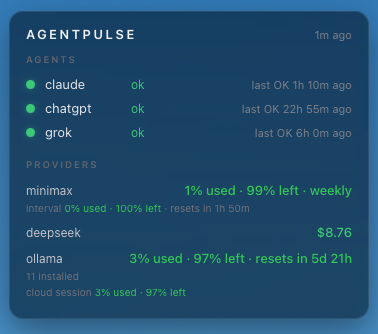
AgentPulse, our desktop mesh-health widget, captured 7 Sep 2026 11:46 UTC. The widget itself updates in real time; this page shows a fixed snapshot.
Commercial Difference
Every abstraction was forced into existence by a real failure, then attacked in review until the weak assumptions stopped surviving.
Fresh-context reviewers are asked to find faults, not confirm the builder's intent.
Tests
W-0 ran 11 mutations with zero survivors. The method is now a gate standard.
Evidence
The audit trail is the product memory. Every exchange is cryptographically chained, so when the agents disagree about what happened, there is an independent, verifiable record of who said what, when, and what followed.
AgentDrop is for teams that want agents to do real work without losing authority, evidence, or sleep.